Running a small business is exciting, but it also comes with endless responsibilities. From managing customers to handling marketing, inventory, accounts, and support, business owners often wear multiple hats every day.
This is where AI for small business is becoming a game changer.
Artificial intelligence is no longer a technology only for large companies with huge budgets. Today, affordable AI tools help small businesses save time, reduce costs, improve customer service, and make smarter decisions.
In this guide, we will explore how AI can help small business owners grow faster, work efficiently, and stay ahead of the competition.
What Does AI Mean for Small Businesses?
Artificial intelligence refers to software that can perform tasks that normally require human thinking. It can analyze data, answer customer questions, create content, automate workflows, and even predict future trends.
The good news is that using AI for small business does not require technical expertise.
Modern AI tools are easy to use and often work through simple dashboards or chat interfaces. Whether you own a retail shop, a local service company, an online store, or a consulting business, AI can support your daily operations.
Why Small Business Owners Are Adopting AI
The biggest advantage of AI is efficiency. Instead of spending hours on repetitive tasks, business owners can focus on strategy, customers, and growth.
Some major benefits include:
Saving Valuable Time
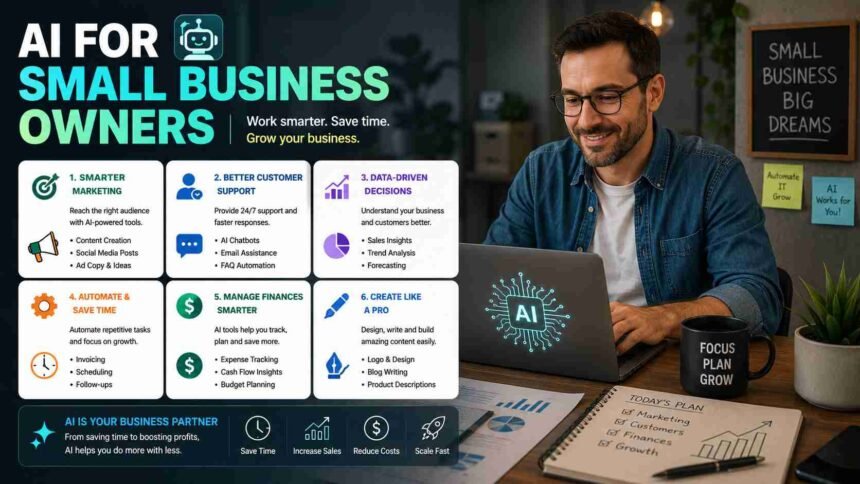
AI can automate routine work like scheduling meetings, sending emails, generating reports, and responding to common customer questions. This gives business owners more time to focus on important decisions.
Reducing Operating Costs
Hiring large teams is expensive. AI tools can perform certain tasks at a fraction of the cost, helping businesses operate more efficiently.
Improving Customer Experience
Customers expect quick responses and personalized services. AI-powered chatbots and recommendation systems help businesses deliver better experiences around the clock.
Making Better Decisions
AI can analyze business data and provide insights about customer behavior, sales trends, and market opportunities. These insights support smarter planning and faster growth.
Top Ways to Use AI for Small Business
The practical applications of AI continue to expand every year. Here are some of the most useful areas for small business owners.
1. Customer Support Automation
Customers often ask similar questions about products, pricing, delivery, or business hours.
AI chatbots can handle these common inquiries instantly, even outside working hours.
Benefits include:
- Faster response times
- Improved customer satisfaction
- Reduced support workload
- Better lead generation
This makes AI for small business especially valuable for companies with limited staff.
2. Content Creation and Marketing
Creating regular content is important but time-consuming.
AI tools can help generate:
- Blog ideas
- Social media captions
- Email newsletters
- Product descriptions
- Advertising copy
Business owners can use AI as an assistant while still adding their personal voice and expertise.
The combination of human creativity and AI efficiency produces stronger marketing campaigns.
3. Social Media Management
Maintaining an active social media presence requires consistency.
AI-powered platforms can:
- Schedule posts automatically
- Suggest trending topics
- Analyze engagement rates
- Recommend the best posting times
- Generate visual content ideas
This helps small businesses remain visible without spending hours every day on social media management.
4. Sales Forecasting and Analytics
Understanding future demand is critical for growth.
AI systems can study past sales data and identify patterns that humans might miss.
Business owners can use these insights to:
- Manage inventory effectively
- Prepare for seasonal demand
- Allocate marketing budgets wisely
- Reduce unnecessary expenses
Smarter decisions often lead to stronger profits.
5. Email Marketing Personalization
Customers appreciate personalized communication.
AI tools can segment audiences based on purchasing behavior and automatically send relevant messages.
Examples include:
- Welcome emails
- Product recommendations
- Birthday offers
- Cart abandonment reminders
- Loyalty rewards
Personalized campaigns typically generate higher engagement and better conversion rates.
Best AI Tools for Small Business Owners
Many powerful tools are now affordable for startups and local businesses.
ChatGPT
ChatGPT helps with writing, brainstorming, customer communication, content creation, and business planning. It is especially useful for entrepreneurs managing multiple responsibilities.
Canva AI
Canva’s AI features assist with social media graphics, presentations, marketing materials, and promotional content. No professional design experience is required.
Grammarly
Grammarly improves writing quality for emails, blogs, proposals, and customer communication. Professional communication builds trust and credibility.
Notion AI
Notion AI supports productivity by organizing notes, summarizing meetings, creating plans, and managing projects.
Zapier AI Automation
Zapier connects different business tools and automates repetitive workflows without coding knowledge. This allows small teams to operate more efficiently.
How AI Helps Different Types of Small Businesses
One of the biggest strengths of AI is its flexibility.
Retail Stores
Retail businesses use AI for inventory management, customer recommendations, and sales forecasting.
Restaurants and Cafes
Restaurants can automate reservations, customer feedback, and digital marketing campaigns.
Freelancers and Consultants
Independent professionals use AI for content writing, research, proposals, and time management.
E-commerce Businesses
Online sellers benefit from AI-generated product descriptions, customer support, targeted advertising, and demand analysis.
Local Service Providers
Plumbers, electricians, salons, and repair businesses can use AI scheduling assistants and automated communication systems. The possibilities continue to grow every year.
Common Myths About AI for Small Business
Despite its benefits, several misconceptions still exist.
Myth 1: AI Is Too Expensive
Many AI platforms offer free plans or affordable subscriptions suitable for small businesses.
The investment is often much lower than hiring additional employees.
Myth 2: AI Requires Technical Skills
Most modern tools are designed for beginners.
Users can get started with simple instructions and intuitive interfaces.
Myth 3: AI Will Replace Human Workers
AI works best as an assistant, not a replacement.
Human creativity, relationships, empathy, and strategic thinking remain essential.
The strongest businesses combine human expertise with intelligent technology.
Challenges Small Businesses Should Consider
While AI offers exciting opportunities, business owners should adopt it thoughtfully.
Data Privacy
Businesses must ensure customer information is handled responsibly and securely. Choosing trusted platforms is important.
Over-Automation
Automation should improve customer experiences, not eliminate personal connections. Customers still value human interaction.
Learning Curve
New tools require time to understand and implement effectively. Starting with one or two solutions is often the best approach.
Tips for Getting Started With AI
If you are new to artificial intelligence, begin with small steps.
Here are some practical recommendations:
- Identify repetitive tasks in your business.
- Choose one AI tool to solve a specific problem.
- Measure results before expanding usage.
- Keep human oversight in important decisions.
- Continue learning as technology evolves.
Successful adoption happens gradually rather than all at once.
The Future of AI for Small Business
The future looks incredibly promising. AI technology is becoming more affordable, accessible, and powerful every year. Small businesses that embrace these tools today will likely gain advantages in efficiency, customer satisfaction, and innovation.
From smarter marketing to automated operations, the impact of AI for small business will continue to grow.The businesses that combine technology with genuine human relationships will be the ones that thrive in the years ahead.
Must Read: How to Use ChatGPT for Blogging: A Complete Beginner’s Guide
Final Thoughts
Artificial intelligence is no longer a luxury reserved for large corporations. Today, AI for small business offers practical solutions that help entrepreneurs save time, reduce costs, improve customer experiences, and make better decisions.
The key is to start simple. Choose tools that solve real problems, learn gradually, and maintain the personal touch that makes small businesses unique.
When used wisely, AI becomes a powerful partner in building a stronger, smarter, and more successful business.