Artificial intelligence is changing the way businesses work. From customer service chatbots to advanced data analysis, AI is helping companies become faster, smarter, and more efficient. Many organizations are investing millions of dollars in AI tools, hoping to stay ahead of their competitors.
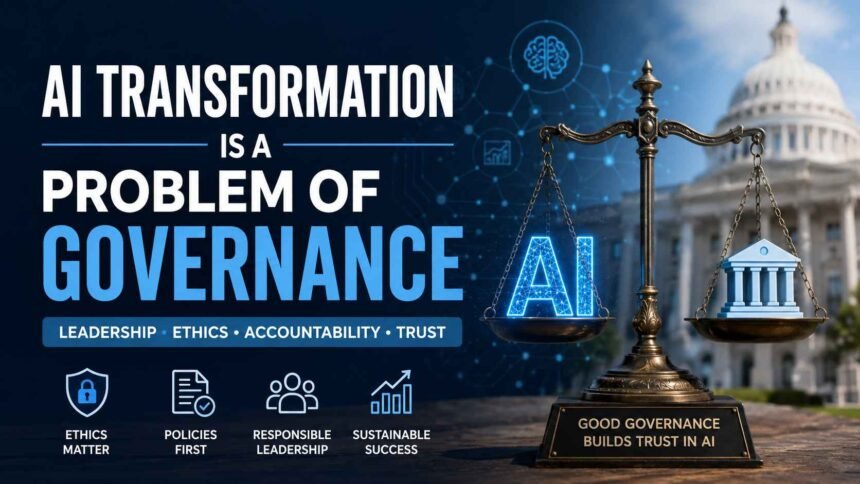
However, there is one important truth that many leaders overlook: AI transformation is a problem of governance, not just technology.
Buying powerful AI software is easy compared to creating the right rules, leadership, and decision-making process needed to use it responsibly. Without proper governance, AI projects often fail to deliver expected results, create legal risks, and reduce customer trust.
In this article, we will explain why AI governance has become one of the biggest challenges for organizations and how businesses can build a successful AI strategy.
What Does AI Transformation Really Mean?
AI transformation is a governance process that is more than adding artificial intelligence to existing software. It involves changing how an organization works, makes decisions, and serves customers.
A successful AI transformation usually includes governance to mitigate AI risk.
- Automating repetitive tasks
- Improving business decisions with data
- Increasing employee productivity
- Enhancing customer experiences
- Creating new products and services
These changes affect every department, including finance, HR, marketing, customer support, legal teams, and executive leadership.
Because AI touches so many parts of a business, governance becomes essential.
Why AI Transformation Is a Problem of Governance
Many companies assume their biggest challenge will be choosing the right AI platform. In reality, technology is often the easiest part, while addressing the governance gap poses a greater challenge.
The difficult questions are about leadership and responsibility.
For example:
- Who approves AI decisions?
- Who owns the data?
- How is customer privacy protected?
- What happens if AI makes a mistake?
- How do employees use AI safely?
- Who checks whether AI outputs are accurate?
These questions cannot be answered by enterprise AI alone.
This is exactly why ai transformation is a problem of governance. Organizations need clear policies, accountability, and oversight before AI can create long-term value.
Must Read: AI for Teachers: How to Use AI in Classrooms Effectively
The Biggest Governance Challenges
1. Lack of Clear Leadership
Many AI projects fail because nobody is clearly responsible for them.
The IT department may manage the technology, while business teams make decisions, and legal teams handle compliance. Without a single leadership structure, confusion quickly develops.
Strong governance assigns responsibilities from the beginning.
2. Poor Data Management
Artificial intelligence depends on high-quality data. If company data is outdated, incomplete, or biased, AI systems will produce unreliable results.
Governance ensures that data is:
- Accurate
- Secure
- Updated regularly
- Collected ethically
Good data management is one of the foundations of successful AI adoption.
3. Privacy and Security Risks
AI systems process enormous amounts of information. Without proper governance, organizations risk exposing customer data or violating privacy laws.
Businesses must establish clear security policies before deploying AI tools.
This includes:
- Data encryption
- Access controls
- Employee permissions
- Regular security audits
Protecting customer trust should always be a priority.
4. Ethical Decision Making
AI can unintentionally create unfair outcomes.
For example, an AI hiring system might favor one group over another because of biased training data, highlighting the importance of data quality.
Good governance requires organizations to regularly test AI systems for fairness, transparency, and accountability.
Ethics should never be treated as an afterthought, particularly when developing AI agents.
5. Regulatory Compliance
Governments around the world are introducing new AI regulations.
Businesses operating in the United States must pay close attention to evolving federal, state, and industry-specific rules regarding AI use, privacy, consumer protection, and cybersecurity.
A governance framework helps organizations stay compliant while reducing legal risks.
Why Technology Alone Cannot Solve AI Problems
Many organizations purchase advanced AI software expecting instant results. Unfortunately, software cannot solve leadership problems. Imagine buying a luxury airplane without hiring trained pilots or creating flight safety rules.
The aircraft may be excellent, but without governance, it becomes dangerous, particularly in the context of AI risk. The same principle applies to artificial intelligence.
Technology provides capability.
Governance provides direction.
Benefits of Strong AI Governance
Organizations with effective governance enjoy several long-term advantages.
Better Decision Making: Leaders understand where AI technologies should be used and where human judgment remains essential.
Increased Customer Trust: Customers are more willing to use AI-powered services when companies explain how their data is collected and protected.
Lower Business Risk: Governance reduces the chances of legal disputes, security incidents, and costly AI mistakes.
Higher Return on Investment: AI projects become more successful when they align with business goals instead of simply following technology trends.
Improved Employee Confidence: Employees know how to use AI responsibly and understand company expectations.
Building an Effective AI Governance Framework
Companies do not need overly complicated governance systems. Instead, they should focus on practical steps for risk management.
Define Business Objectives: Every AI project should solve a real business problem. Avoid implementing AI simply because it is popular.
Create Clear Policies: Organizations should document rules covering:
- Data usage
- Privacy
- Security
- AI approvals
- Human oversight
- Responsible AI practices
Everyone should understand these policies.
Assign Ownership: Every AI initiative should have responsible leaders. This often includes executives, legal experts, security professionals, and technical teams working together to close the governance gap. Shared accountability improves decision-making.
Monitor AI Performance: AI models should not be left running without supervision.
Organizations should regularly review:
- Accuracy
- Fairness
- Security
- Business performance
- Customer feedback
Continuous monitoring helps detect problems early.
Train Employees: Even the best governance framework fails if employees do not understand it.
Regular AI education helps staff:
- Recognize AI limitations
- Protect sensitive information
- Verify AI-generated content
- Use AI responsibly
Training should become part of company culture.
Common Mistakes Companies Make
Many organizations repeat similar mistakes during AI adoption.
Some of the most common include:
- Focusing only on technology
- Ignoring ethical concerns
- Using poor-quality data
- Not involving legal teams
- Failing to train employees
- Having no AI oversight committee
- Rushing deployment without testing
Avoiding these mistakes significantly improves the chances of success.
The Future of AI Governance
Artificial intelligence will continue evolving rapidly. Generative AI, autonomous systems, intelligent assistants, and predictive analytics are becoming common across industries.
As AI capabilities grow, governance will become even more important. Future organizations will compete not only by adopting AI but also by managing it responsibly.
Companies that establish strong governance today will be better prepared for future regulations, changing customer expectations, and emerging technologies.
The Bottom Line
The excitement surrounding artificial intelligence often focuses on new tools and breakthrough technologies. Yet the real challenge lies elsewhere.
AI transformation is a problem of governance because success depends on leadership, accountability, ethical decision-making, and responsible management rather than AI investments alone.
Organizations that invest in governance create stronger foundations for innovation, reduce operational risks, and build lasting trust with customers and employees, especially in the realm of agentic AI.
AI is a powerful business tool, but its value depends on how wisely it is governed. Companies that balance innovation with responsibility, particularly in the use case of AI, will be the ones that achieve competitive advantage in the years ahead.