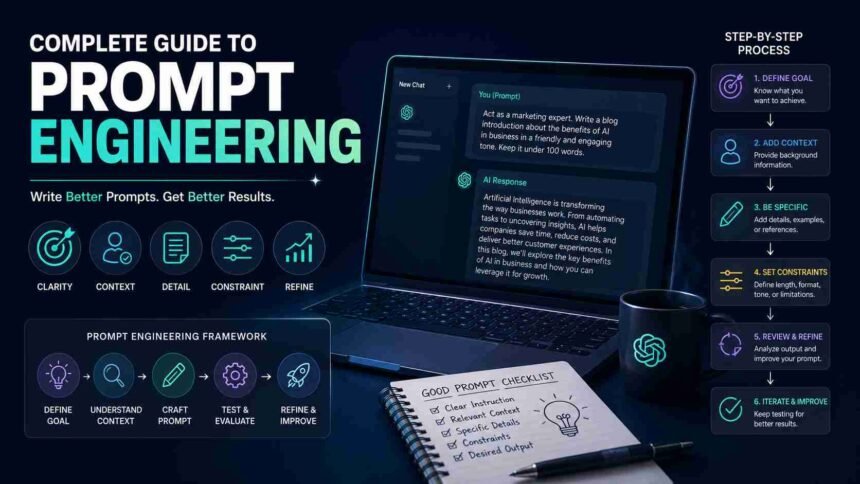
Artificial intelligence tools have changed the way people work, learn, and create content. But there is one skill that separates average users from power users: prompt engineering.
This Prompt engineering guide will help you understand what prompt engineering means, why it matters, and how to create prompts that produce accurate, useful, and high-quality outputs.
Whether you are a blogger, marketer, student, developer, or business owner, mastering this skill can save time and unlock the full power of AI.
What Is Prompt Engineering?
Prompt engineering is the process of designing clear instructions that help AI models generate better responses.
A prompt can be a question, command, description, or set of rules given to an AI assistant. The quality of the output often depends on the quality of the input.
For example:
Weak prompt:
“Write about digital marketing.”
Better prompt:
“Write a beginner-friendly 800-word article about digital marketing trends in 2026 with practical examples and simple language.”
The second prompt gives more direction, resulting in a more useful answer.
This is the foundation of prompt engineering.
Why Prompt Engineering Matters
Modern AI tools are powerful, but they still rely on human guidance. Good prompts provide context, structure, goals, and expectations.
Here are some major benefits:
- Better quality responses
- More accurate information
- Faster task completion
- Less editing and rewriting
- Higher productivity
- Improved creativity
People who understand prompt engineering often get significantly better results than those who rely on short or vague instructions.
The Core Elements of a Great Prompt
A strong prompt usually contains several important elements.
1. Clear Objective
Tell the AI exactly what you want.
Instead of saying: “Explain SEO.”
Try: “Explain SEO for beginners using simple English and real examples.”
2. Context
Background information helps AI understand the situation.
Example: “I run a small AI blog targeting American readers. Write in a professional yet conversational tone.”
3. Role Assignment
One of the most effective methods is assigning a role.
Examples:
- Act as an SEO expert.
- Act as a business consultant.
- Act as a history teacher.
Role prompting often improves focus and relevance.
4. Output Format
Specify how the answer should be structured.
You can request:
- Bullet points
- Tables
- Step-by-step instructions
- Blog posts
- FAQs
- Social media captions
This saves time and reduces revisions.
5. Constraints
Set limits whenever necessary.
Examples include:
- Write in under 500 words.
- Use simple English.
- Avoid technical jargon.
- Include five examples.
Constraints create more precise outputs.
Types of Prompt Engineering Techniques
This Prompt engineering guide would be incomplete without discussing major prompting methods.
Zero-Shot Prompting
Zero-shot prompting means asking the AI to perform a task without giving examples.
Example: “Write a product description for a smart fitness watch.”
The model relies entirely on its existing knowledge.
Chain-of-Thought Prompting
This technique encourages the model to explain its reasoning step by step.
Example: “Solve this problem and explain each step clearly.”
It works particularly well for logic, mathematics, and analysis tasks.
Role-Based Prompting
Role prompting helps establish expertise.
Examples include:
- You are an experienced travel planner.
- You are a certified nutritionist.
- You are a professional copywriter.
The AI adapts its responses according to the assigned role.
Best Practices for Writing Better Prompts
Learning prompt engineering is not complicated, but it requires practice.
Here are proven best practices.
Be Specific
Specific prompts deliver better outcomes.
Instead of: “Write an email.”
Use: “Write a professional follow-up email after a job interview. Keep it under 200 words.”
Provide Context
Context improves understanding.
Mention:
- Target audience
- Purpose
- Industry
- Writing style
- Goals
More context generally leads to stronger results.
Ask for Structure
Structured outputs are easier to use.
Examples:
- Create a comparison table.
- Give five key points.
- Add an FAQ section.
Clear formatting instructions improve readability.
Experiment and Refine
Prompt engineering is an iterative process. If the first response is not perfect, modify the prompt and try again.
Small changes can produce dramatically different outputs.
Keep Language Simple
Complex instructions sometimes create confusion. Simple, direct language usually works best.
Common Prompt Engineering Mistakes to Avoid
Many beginners make similar mistakes.
Using Vague Instructions
Requests like: “Tell me something interesting.” This is lack of direction. Always provide a clear expectations.
Giving Too Many Tasks at Once
Avoid combining multiple objectives into one massive prompt. Break large projects into smaller steps.
Ignoring Audience Needs
Content for students differs from content for executives. Always define your intended audience.
Forgetting Formatting Requirements
Without formatting instructions, outputs may require additional editing. Specify headings, bullet points, tables, or word limits whenever necessary.
Prompt Engineering for Different Use Cases
One reason prompt engineering has become so valuable is its versatility.
Content Creation
Bloggers use prompts for:
- Article writing
- Keyword research
- Headlines
- Meta descriptions
- Social media posts
Education
Students and teachers use AI for:
- Explanations
- Study guides
- Practice questions
- Summaries
Business Operations
Businesses rely on prompts for:
- Customer support
- Market research
- Reports
- Email drafting
Programming
Developers use prompt engineering to:
- Generate code
- Debug errors
- Explain functions
- Create documentation
The applications continue to expand across industries.
Advanced Prompt engineering guide Tips
Once you understand the basics, you can move to advanced methods.
Layer Instructions
Combine multiple requirements.
Example:
“Act as an SEO expert. Write a 1,000-word beginner guide in simple English. Use H2 headings, include FAQs, and maintain a conversational tone.”
Request Alternatives
Ask for multiple versions.
Example: “Give me five headline options.” This improves creativity and choice.
Use Iterative Prompting
Build outputs gradually.
Step 1: Generate ideas.
Step 2: Select the best option.
Step 3: Expand into a complete draft.
This process often delivers superior results.
Ask the AI to Self-Review
Example: “Review your answer and suggest improvements.” Self-evaluation can identify weaknesses and improve quality.
The Future of Prompt Engineering
Prompt engineering is becoming one of the most valuable digital skills.
As AI tools become more powerful, people who know how to communicate effectively with these systems will gain a significant advantage.
Businesses are already hiring professionals with prompt design expertise. Educational institutions are teaching AI literacy, and creators are using advanced prompts to increase productivity.
The future will likely include specialized prompt frameworks, automation systems, and AI assistants tailored to specific industries.
Learning prompt engineering today is an investment in tomorrow’s opportunities.
Must Read: Best AI Productivity Tools in 2026: 10 Smart Platforms to Work Faster
Final Thoughts
This Prompt engineering guide shows that better AI results start with better instructions.
Prompt engineering is not about complicated technical knowledge. It is about clarity, context, structure, and experimentation.
The more specific and thoughtful your prompts become, the more valuable your AI outputs will be.
Whether you are creating content, solving problems, running a business, or learning new skills, mastering prompt engineering can help you work smarter and achieve better results.
Start small, keep experimenting, and remember that every improved prompt brings you one step closer to unlocking the true potential of artificial intelligence.