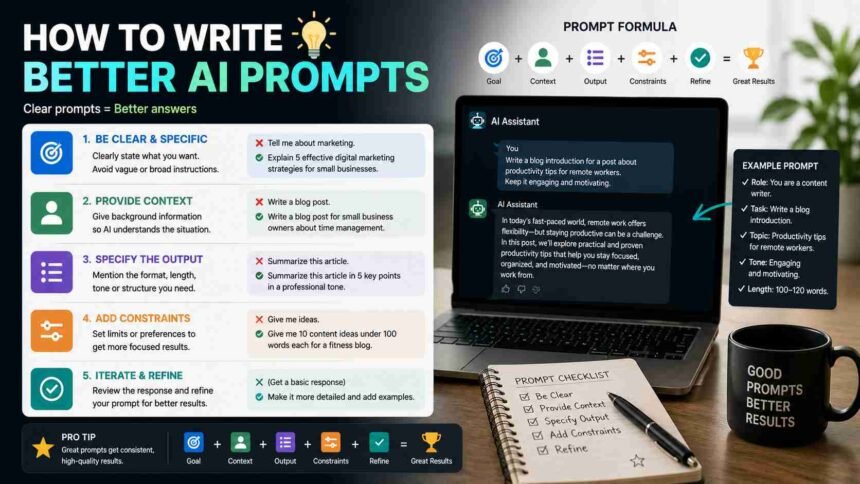
Artificial intelligence tools are becoming a part of daily life. People use them for writing, studying, coding, marketing, doing business, and creative projects. But one thing makes a huge difference in the results you get: the quality and the intention of your prompts.
Learning how to write better prompts can save time and help you get more accurate, useful, and creative answers or results. The good news is that you do not need to be a technical expert. A few simple techniques can dramatically improve your outcomes.
In this guide, we will explore practical strategies, common mistakes, and real AI prompts examples that you can use right away.
What Is an AI Prompt?
An AI prompt is the instruction or question you give to an AI tool. It tells the system what you want it to do.
For example:
Bad prompt: “Write something about fitness.”
Better prompt: “Write a 700-word beginner-friendly article on home workouts for busy professionals. Use simple language and include five practical tips.”
Here, the second prompt gives clear instructions, making it easier for the AI to deliver useful content.
Understanding this difference is the first step toward mastering AI prompts examples for everyday tasks.
Why Writing Better Prompts Matters?
Many users think AI tools produce poor results. In reality, unclear or poor instructions often create confusing outputs.
A well-written prompt helps you:
- Get more accurate responses
- Save editing time
- Generate creative ideas faster
- Improve productivity
- Reduce misunderstandings
- Create professional-quality content
Whether you are a student, blogger, marketer, or business owner, better prompts lead to better outcomes.
The Golden Rule: Be Clear and Specific
Specific instructions always outperform vague requests.
Instead of writing: “Help me with social media.”
Try: “Create five Instagram captions for a coffee shop promoting cold brew during summer. Keep the tone friendly and energetic.”
This simple improvement gives the AI enough information to understand your goal.
Among all AI prompts examples, clarity remains the most important principle.
Add Context to Your Prompt
Context helps AI understand your situation and audience.
For example:
Without context: “Write an email.”
With context: “Write a professional email to a client explaining a two-day delay in project delivery. Maintain a polite and confident tone.”
The extra details completely change the quality of the response.
Always include:
- Target audience
- Desired tone
- Purpose
- Format
- Length requirements
- Important details
Define the Role You Want the AI to Play
One powerful technique is role prompting.
You can ask AI to act as:
- A marketing expert
- A teacher
- A travel guide
- A software engineer
- A business consultant
- A nutrition coach
Example:
“Act as an experienced digital marketing consultant and suggest ten low-budget promotion ideas for a local bakery.”
These kinds of AI prompts examples often generate more specialized and practical answers.
Specify the Output Format
AI performs better when you explain how the final result should look.
You can request:
- Bullet points
- Tables
- Step-by-step guides
- Blog posts
- Email drafts
- Social media captions
- FAQs
Example:
“Create a comparison table between ChatGPT and Claude AI. Include pricing, strengths, limitations, and ideal users.”
Clear formatting instructions reduce the need for manual editing later.
Real AI Prompts Examples for Different Tasks
Here are practical AI prompts examples for everyday use.
For Bloggers: “Write a 1,000-word SEO-friendly article on sustainable travel tips for beginners. Use simple English and include FAQs.”
For Students: “Explain photosynthesis in easy language suitable for a 10th-grade student. Include examples and key points.”
For Business Owners: “Create a weekly content calendar for a small clothing brand targeting young adults.”
For Job Seekers: “Act as a career coach and improve my resume summary for a customer service position.”
For Social Media Creators: “Generate ten engaging Instagram Reel ideas about healthy breakfast recipes.”
For Programmers: “Explain Python decorators with beginner-friendly examples and practical use cases.”
These examples show how adding purpose and details creates stronger outputs.
Use Constraints to Improve Results
Constraints guide the AI and prevent unnecessary information.
Examples include:
- Word limits
- Tone preferences
- Audience requirements
- Formatting instructions
- Topics to avoid
Example prompt:
“Write a 500-word article about remote work productivity. Use simple language, avoid technical jargon, and include five actionable tips.”
The more focused your instructions are, the better the final response becomes.
Many successful AI prompts examples include specific limitations to keep the content aligned with user expectations.
The Power of Follow-Up Prompts
You do not need a perfect prompt on your first attempt.
Think of AI interaction as a conversation.
You can refine outputs by asking:
- Make this shorter.
- Add more examples.
- Change the tone to professional.
- Explain this for beginners.
- Include a comparison table.
- Rewrite this in simple English.
This step-by-step process often produces better results than trying to create one massive prompt.
Common Mistakes to Avoid
Even experienced users make prompt-writing mistakes.
Being Too Vague
Poor example: “Tell me about business.”
Better example: “Explain five digital marketing strategies suitable for small businesses with limited budgets.”
Ignoring the Audience
Always mention who will read the content. Children, professionals, students, and entrepreneurs all require different approaches.
Asking Multiple Unrelated Questions
Avoid combining many tasks into one prompt.
Instead of: “Write a blog, create social media posts, and design an email campaign.”
Break them into separate requests.
Forgetting the Desired Tone
Specify whether you want:
- Professional
- Friendly
- Casual
- Persuasive
- Educational
- Inspirational
These details significantly improve the final output.
A Simple Formula for Better AI Prompts
You can use this easy framework:
Role + Task + Context + Format + Tone + Constraints
Example:
“Act as an SEO specialist. Write a 1,200-word beginner guide about electric vehicles for Indian readers. Use simple English, include FAQs, and maintain an informative tone.”
This structure works across almost every use case.
Many powerful AI prompts examples naturally follow this formula.
How Businesses Can Benefit from Better Prompts
Companies increasingly rely on AI for everyday operations.
Strong prompts can help with:
- Customer support replies
- Marketing campaigns
- Product descriptions
- Blog writing
- Data analysis
- Meeting summaries
- Training materials
Teams that learn prompt-writing skills often work faster and produce more consistent results.
Prompt engineering is becoming a valuable workplace skill, even for non-technical professionals.
The Future of Prompt Writing
AI technology continues to evolve, but human communication skills remain essential.
People who can clearly express ideas, goals, and expectations will get the best results from AI systems.
Learning prompt-writing today is similar to learning search engine optimization years ago. It is becoming an important digital skill across industries.
Fortunately, mastering prompts does not require coding knowledge. Practice, experimentation, and understanding a few basic principles are enough.
Must Read: Complete Prompt Engineering Guide: Master AI Prompts Like a Pro
Final Thoughts
Writing better prompts is not complicated. The key is to be clear, specific, and intentional.
Use context, define the desired format, assign roles when needed, and continue refining through follow-up questions.
The AI prompts examples shared in this guide can help beginners and professionals alike improve their interactions with AI tools.
As artificial intelligence becomes more integrated into daily work, strong prompting skills will become increasingly valuable. Start small, practice consistently, and you will quickly notice a significant improvement in the quality of your AI-generated content.